, , , ,

Microsoft Windows 7 32-bit or 64-bit ?

[ Tuesday, November 10, 2009 | View Comments ]

The right choice of Windows 7 versions depends on a number of factors. Let my FAQ be your guide ! :)
For most would-be Windows 7 users, a 64-bit version of Windows 7 is the right move. But if you don't have sufficient RAM (at least 4GB), or you rely on devices that don't have supporting 64-bit drivers, or you need to upgrade an existing 32-bit installation, 32-bit Windows 7 might be the better choice. A few editions of 64-bit Windows 7 provide a Windows XP Mode that solves some backward-compatibility problems, but it isn't a universal panacea. In speedy Q&A format, here's just what you need to know.


Question: Is my PC supported under 64-bit Windows 7?

Ans: Most PCs manufactured in the past three years (i.e. after Vista's debut) are capable of running 64-bit Windows 7. The exceptions are those that ship with low-end CPUs that don't support the AMD or Intel 64-bit extensions. Examples include Intel's Atom line of low-powered CPUs and early Intel Core CPUs, like the Core Duo (not Core 2 Duo). If you're not sure what kind of CPU is in your system, or whether the CPU supports 64-bit operation, you can use the free Intel Processor Identification Utility to find out.

Question 2: What about all of my peripherals?

Those who don't know what are Peripherals: these are devices attached to a host computer but not part of it whose primary functionality are dependent upon the host, and can therefore be considered as expanding the host's capabilities, while not forming part of the system's core architecture.

Ans: As with PC support, most peripherals manufactured in the Vista era work with 64-bit Windows 7. However, legacy hardware support is a hit-or-miss proposition. Some manufacturers -> for example, vendors of network interface cards or disk storage controllers -> are more up to date than others, thanks in part to the fact that they've been supporting 64-bit computing under Windows Server since the 2002-2003 timeframe.

Devices that don't have obvious ties to the data-center (such as custom input devices, multimedia hardware, and some printers) can be harder to integrate since they were manufactured at a time when 64-bit desktops were a rarity. Your best bet is to do a Web search to see if the manufacturer has published a 64-bit device driver and, barring that, if other users have come up with a solution.


 Source: InfoWorld
, , , ,

Ubuntu 9.10 Linux Creator Calls Windows 7 'Excellent Release'

[ Sunday, November 8, 2009 | View Comments ]


 But Mark Shuttleworth gives 3 reasons why latest Ubuntu may make headway against Microsoft !
 
Mark Shuttleworth, founder and CEO of Canonical Ltd., the maker of the most popular desktop Linux alternative to Microsoft Corp.'s Windows, not only claims to be "delighted" that Windows 7 is out, but calls the new operating system an "excellent release." Wow !


"It's a substantial improvement on the past. Even on netbooks, it's a credible release," Shuttleworth said on the October 26, 2009, during a conference call launching the Ubuntu 9.10 operating system.
Ubuntu 9.10's launch five days after Windows 7's is no coincidence. For the past several years, Ubuntu has carried the Linux community's flag in its valiant-ut-so-far-unsuccessful attempts to erode Windows' dominance in the desktop PC market. :(

Ubuntu and Linux generally continue to be hamstrung by the operating system's technically forbidding image, its smaller selection of applications and games, device compatibility issues, and the reluctance of PC makers to preinstall Linux, due to its lack of popularity and the desire to keep good relations with Microsoft.

But Shuttleworth sees three potential openings for Ubuntu and other desktop alternatives to Microsoft's OS. First, Microsoft is continuing to hawk Windows XP to netbook makers, despite the eight-year-old operating system being a "ghost" of a platform at this point, he said.

Second, Microsoft hopes PC makers will adopt the pricier Windows 7 Starter Edition over XP despite what Shuttleworth describes as "significant restrictions" on its capabilities compared with full-fledged versions of Windows 7.

Finally, Windows "remains a proprietary and relatively expensive piece of technology," Shuttleworth said. For those reasons, "I'm quite confident," he added after that.

Linux initially led the netbook market, though that was quickly cut short after Microsoft, as Shuttleworth put it, "clawed back" with Windows XP.

Today, Ubuntu supports 25 netbook models, with Dell Inc, being the biggest supporter. Most of those shipments go outside of the U.S. "I would love to have another stab at the U.S. market," Shuttleworth said.

Formerly code-named "Karmic Koala," Ubuntu 9.10 offers many improvements on driver compatibility, according to Shuttleworth.

"On printers, we use the same subsystem as Apple Inc.'s Macs, so I'm very confident that we've covered all the bases there," he said. On video cards and network cards, "there is a tremendous amount of energy being invested. The story is improving rapidly."

The most glaring hardware incompatibility with Ubuntu, he said, is Apple's iPhone.

Formerly a desktop-only distribution of Linux, Canonical is investing heavily in a server version of Ubuntu 9.10 with cloud features and Amazon EC2 and S3 compatibility.

"We want to deliver Ubuntu as an end-to-end solution," Shuttleworth said. "By 2010, there will be people developing for Ubuntu on ARM smartbooks as well as deploying it on Intel Xeon servers in the cloud."

While saying that Google Inc.'s Linux-based ChromeOS platform "doesn't threaten us, but energizes us to get the desktop right," Shuttleworth also took a subtle jab at Google's Web-first vision.

"We think the desktop still has a critical role in the cloud-oriented world," he said. "We'd rather deliver services to desktop apps directly rather than through a Web browser." Yeah !

Long live Windows Corp. & Karmic Koala !
Source: ComputerWorld
, ,

Incredible Open Courses for the Ultimate Tech Geek

| View Comments ]


While colleges can be a great place to build up your knowledge of technologies of all kinds, real world experience and Free learning resources on the web can do a pretty good job of showing you the ropes as well. Here are 100 free resources that can help you hone your techie skills and learn more about the ever-changing world of technology !


First of all I would like to explain to you some keywords like :

MIT: Massachusetts Institute of Technology, is devoted to the advancement of knowledge and education of students in areas that contribute to or prosper in an environment of science and technology.

Openlearn: Open educational resources from The Open University. Free online learning materials for all to use.

TWB: Teachers Without Borders supports teacher-leaders, worldwide, because they play a vital role in their communities.

USU: Utah State University

Computer Science and Engineering

These courses offer you a chance to learn about everything from electrical engineering to the basics of computer science.

  1. Data and Processing in Computers: Learn just how computers and software work in this free course. [OpenLearn]
  2. Theory of Computation: This course will help you learn some of the more advanced theories behind how computers operate. [MIT]
  3. Introduction to Computer Science and Programming: Start from the beginning in your computer science education with this course. [MIT]
  4. Structure and Interpretation of Computer Programs: Take this course to learn some basic programming skills and how to work within computer systems. [MIT]
  5. Signals and Systems: Here you can learn about the basics of systems and signals analysis. [MIT]
  6. Topics in Theoretical Computer Science: Internet Research Problems: With so much being based around the web these days, this course will help you learn to develop systems and solve problems using the internet. [MIT]
  7. Great Ideas in Theoretical Computer Science: This course offers a great introduction to the theories of computer science, from the beginnings of computer systems to the present day. [MIT]
  8. Pervasive Human Centric Computing: Try out this course to learn about all kinds of computing devices in addition to the personal computer. [MIT]
  9. Circuits and Electronics: Through this course, students will learn the essentials of electrical engineering. [MIT]
  10. Computation Structures: Learn about engineering digital computer systems from this course. [MIT]
  11. Computer System Engineering: Check out this course to get an education on the engineering of computer software and hardware systems. [MIT]
  12. Microelectronic Devices and Circuits: This course offers learners the chance to expand their knowledge of modeling of microelectronic devices, basic microelectronic circuit analysis and design, physical electronics of semiconductor junction and more.
  13. Videogame Theory and Analysis: Study the social and educational implications of video games in this course. [MIT]
  14. Artificial Intelligence: This course will introduce students to the representation, problem solving, and learning methods of artificial intelligence.[MIT]
Computer Security 

There isn’t much point in having an awesome tech setup if it’s at risk of being destroyed by hackers or digital ne’er-do-wells. These courses will help you learn to keep information and systems secure.


  1. Cryptography and Cryptanalysis: This course will introduce students to public-key encryption, digital signatures, pseudo-random number generation, and basic protocols. [MIT]
  2. Advanced Topics in Cryptography: Expand on your knowledge of cryptographic topics with this great free course. [MIT]
  3. Network Security: Learn how to secure your networks at home and at work with this course. [OpenLearn]
  4. An introduction to information security: Try out this course to learn the basics of information security. [OpenLearn]
  5. Selected Topics in Cryptography: Examine special topics in cryptography in this course, like cryptographic protocols and secure voting systems. [MIT]
  6. Network and Computer Security: Through this course you can learn everything from risk assessment to protecting software. [MIT]
Programming 

Check out these courses to learn the basics of several different programming languages.


  1. Introduction to Software Engineering in Java: Take this course to learn how to use Java to build computer programs. [MIT]
  2. Building Programming Experience: If you want to expand on your existing programming knowledge, consider going through the resources offered in this course. [MIT]
  3. Java Preparation: If you know little to nothing about Java, take this course to get a good foundation. [MIT]
  4. Essential Coding Theory: Learn about the past and present of the theory of error-correcting codes. [MIT]
  5. Programming Languages: While this course uses the Scheme + programming language, you’ll learn the fundamentals that apply to many other languages as well. [MIT]
  6. Nonlinear Programming: Address some of the less straightforward problems with programming in this course. [MIT]
  7. Dynamic Programming and Stochastic Control: Learn how to make decisions under uncertain conditions when programming through this course. [MIT]
  8. A Gentle Introduction to Programming Using Python: This course will make learning Python painless and useful. [MIT]
  9. Program Analysis: Here you’ll learn how to turn a critical eye towards several major programming issues in this course. [MIT]
  10. Computer Language Engineering: Through this course you’ll learn how to implement advanced programming languages. [MIT]
  11. Introduction to C++: Go through the materials offered by this course to learn how to use C ++. [MIT]
The Web 

From building a website to understanding how the web works, these courses offer a great variety of learning opportunities.


  1. Ethics and the Law on the Electronic Frontier: Examine the legal issues that face working on the web and protecting copyrights in the digital era. [MIT]
  2. Social Visualization: This course will take you through learning how to create a visual representation of the visitors to any given websites. [MIT]
  3. People-centered Design: From amusement park rides to elevators, this course will help you learn more about creating products that work for users. [OpenLearn]
  4. Designing Sociable Media: Learn how the design of a website influences how people use it to interact and get a chance to build your own social media in this course. [MIT]
  5. Flash: If you’ve never learned how to use Flash, this course offers a great introduction. [USU]
  6. Learn and Apply HTML: Most of the web is still based around an HTML framework, so learning how to use the programming language through this course can be a big help. [USU]
  7. Fundamentals of Computational Media Design: Take this course to learn about the history of 20th century art and design from the perspective of the technologist. [MIT]
  8. Interactive Multimedia Production: Through this course you’ll use Flash to build online programs that users can interact with. [USU]
  9. Writing on Contemporary Issues: Culture Shock! Writing, Editing, and Publishing in Cyberspace: This English course teaches students some of the challenges and advantages to publishing work online. [MIT]
Software 

Learn more about the world of software engineering and design from these courses.


  1. Computer Graphics: Learn how to build computer graphics in this course that teaches students about the computer graphics hardware, algorithms, and software needed. [MIT]
  2. User Interface Design and Implementation: A great program isn’t particularly useful if it isn’t user friendly, and this course will focus on teaching how to build great, easy-to-navigate interfaces. [MIT]
  3. The Software Business: If you’ve got a great idea for a software product, you can use this course to learn about the business side of things and how you can get your product on the market. [MIT]
  4. Laboratory in Software Engineering: Through this course students will be able to learn how to build software from the ground up. [MIT]
  5. Structure and Interpretation of Computer Programs: Take this course to learn how to apply computer programming methods to solve computational problems. [MIT]
  6. Foundations of Software Engineering: This introductory course is a great place to get started learning more about software engineering. [MIT]
  7. Common Sense Reasoning for Interactive Applications: Take advantage of the knowledge users already process when designing user interfaces in this course. [MIT]
  8. Program Analysis: Learn how to look critically at the way programs are working with a little help from this course. [MIT]
  9. Designing the user interface: text, colour, images, moving images and sound: Learn about the important role all of these aspects play in engaging users. [OpenLearn]
Information Technology 

Whether you want to be an IT professional or just get a better understanding of the field, these courses can help.


  1. Database Systems: Here you can learn about the foundations of database systems. [MIT]
  2. Information Technology I: Take this introductory course to learn about some of the essentials in information technology. [MIT]
  3. Global Issues in Information Technology: Learn how culture influences how technologies are used in this course. [TWB]
  4. Database, Internet, and Systems Integration Technologies: This course is billed as an intensive review of information technology topics, including software development, databases and web development. [MIT]
  5. Data Structures and Programming Methodology: This course will teach you about the math used in information technology and the multiple ways information and data can be organized. [UC Berkeley]
  6. Computer Networks: Through this course you’ll learn more about global networks and the principles on which they are organized. [MIT]
  7. Networks: Theory and Application: Here you can learn about a variety of networking topics from social networks to applications in information networks such as the Internet. [U of Michigan]
  8. Information Technology and the Labor Market: Learn how the prevalence of IT is reshaping the American labor market. [MIT]
  9. Information Technology Essentials: Make sure you’ve got down the basics of what it takes to understand information technology with some guidance from this course. [MIT]
  10. Practical Information Technology Management: Take this course to learn how to make sound business decisions when it comes to IT. [MIT]
Communication Technology 

These courses address everything from cell phones to communication systems.


  1. High Speed Communication Circuits and Systems: This course will address the important issues in circuit design in communication devices. [MIT]
  2. Data Communication Networks: Learn why networks are structured the way they are and how they might change in the future in this course. [MIT]
  3. Communicating in Cyberspace: Here students will learn to think critically about developing communications systems for use on the internet. [MIT]
  4. Digital Communications: Take a closer look at optical fiber links in this course. [MIT]
  5. Principles of Wireless Communications: This course will cover the design, analysis, and fundamental limits of wireless transmission systems.[MIT]
  6. Intro to Tech Communication: While having technical knowledge is great, this course addresses how to improve communication so you can get your ideas out there. [MIT]
  7. Communication Systems Engineering: Learn what goes into designing and building communications systems for aerospace, satellites, and deep space devices. [MIT]
  8. Transmission of Information: This course will help you learn more about the quantitative theory of information. [MIT]
  9. Communication Systems I: Split into two parts, this first course will teach students about basic analog systems. [USU]
  10. Principles of Digital Communications: This course will help students gain a better understanding of how modern communication devices work. [MIT]
Technology in Education 

Use these courses to get an idea of how technology is changing education.


  1. Technologies for Creative Learning: Take a look at this course to consider how technology can help people learn new things in exciting ways. [MIT]
  2. Computer Games and Simulations for Investigation and Education: This course will teach you how people learn from interactive computer environments and encourage students to develop their own learning systems. [MIT]
  3. Educational Technologies in Learning Theories: Through this course you can learn about several different learning theories and the role technology can play in each of them. [TWB]
  4. Producing Distance Education Resources: Learn how to build better resources for distance learning through this course. [USU]
  5. Networks for Learning: Here you can take a course that focuses on the problem of supervised learning within the framework of Statistical Learning Theory. [MIT]
  6. How to Learn (Almost) Anything: Check out this course to learn how digital technologies can be used to teach just about anything. [MIT]
  7. Digital Libraries: Learn more about the future of the library through this course. [U of Michigan]
  8. Technological Tools for School Reform: From cheap laptops to schools better using technology, this course offers ideas for change through a technological lens. [MIT]
  9. Information and Communication Technology in Education: In this course you’ll learn why it’s so important to teach students how to use computers. [TWB]
  10. Blogs, Wikis, New Media for Learning: Take a look at this course to discover what role these new technologies might play in the classroom. [USU]
  11. Autism Theory and Technology: In this course you’ll learn not only about autism, but also about the role technology can play in making it easier for these kids to learn and interact with others. [MIT]
Tech Math 

Make sure you understand the principles behind the technology you’re using with these great courses.


  1. Introduction to Algorithms: Take a look at this course material to get a handle on the basics of algorithms. [MIT]
  2. Introduction to Mathematical Programming: This course will take you through the numbers behind all the programming. [MIT]
  3. Distributed Algorithms: Learn about the latest research in this field through this informative and cutting-edge course. [MIT]
  4. Automata, Computability, and Complexity: Take this course to learn more about topics like finite automata and regular languages, context-free languages, Turing machines, partial recursive functions and more. [MIT]
  5. Mathematics for Computer Science: Math is important to computer science, so learn how to do everything from the basics to more complex problems in this course. [MIT]
  6. Probabilistic Systems Analysis and Applied Probability: We live in an uncertain world, and this course offers a chance to understand the math behind probability. [MIT]
  7. Advanced Calculus for Engineers: If you’re more focused on the design side of things, this course can give you the math background you need. [MIT]
  8. Topics in Theoretical Computer Science: An Algorithmist’s Toolkit: Take this course to learn about some of the geometric tools used in defining algorithms. [MIT]
  9. Quantum Computation: In this course you’ll get a chance to learn about the physics of information processing, quantum logic, and quantum algorithms. [MIT]
  10. Principles in Applied Mathematics: Here you’ll learn about the role math plays in coding, engineering and more. [MIT]
Technology and Society 

Take these courses to learn about the cultural and social implications of technology.


  1. Technology in American History: Going back to colonial times, this course will address the role in which technology has played in shaping American history. [MIT]
  2. The History of Computing: Learn about computers from their infancy to the present day in this course. [MIT]
  3. Technology and Nature in American History: Take this course to learn how the term "nature" has been shaped by industrial practices. [MIT]
  4. Technology and Gender in American History: Technology is often considered a man’s world, but this course addresses the myriad of roles women have played and the changing relationship between the sexes and new technology. [MIT]
  5. Technology in a Dangerous World: Check out this course to better understand the relationship between terrorism and technology. [MIT]
  6. Technology and Culture: Here you’ll learn about the effects technology has had on culture around the world and whether or not it has changed things for the better. [MIT]
  7. The Anthropology of Computing: Look at computers and their role in human society from an anthropological standpoint in this course. [MIT]
  8. Introduction to the History of Technology: While you might be more interested in modern technology, understanding the roots of the gadgets you use could be useful, and this course will educate you on just that. [MIT]
  9. Social and Political Implications of Technology: Take a look at how technology influences how society is organized and how people behave in this course. [MIT]
  10. Cultural History of Technology: This course explains that the idea of technology is relatively new and explores the effect it has had on how people define themselves and their world. [MIT]

Hope this article be of a great help to you. Knowledge is Power ! :)

Source: OnlineCourses
, , ,

Area 51 – The Restricted Area

[ Monday, November 2, 2009 | View Comments ]


Area-51, what's so special about Area-51? It is a top-secret military test and development facility. It is owned and operated by the US Air Force of course. It is located within the Nevada Test and Training Range, which is 85 miles north of Las Vegas.

Area 51, was founded in "1955" to test the newly developed U-2 Spy Plane. Since then the base was constantly expanded, and used for various so called Black Project developments including the A-12 "Blackbird", the F-117 Stealth Fighter and the B-2 Stealth Bomber. More recent projects include research on Stealth Technology, various unmanned investigation and combat aircraft (UAVs and UCAVs) and possibly a rumored high speed high altitude platform known as "Aurora".

Some believe that the research at Area 51 also includes Alien technology. However, there is credible evidence to support such claims. What do you say ? Umm... Perhaps you don't know, that right now you are being observed ! Beware !


Where exactly do you think is Area-51 ?

Area 51 is exactly situated within the Nevada Test and Training Range complex in southern Nevada, about 85 miles north-west of Las Vegas. It is hidden in the mountains around Groom Lake, one of many dry lake beds in the area, near the "Extraterrestrial Highway" 375 and the town of Rachel, NV...

The location of the base, in a valley surrounded by mountain ranges that are off-limits to the public, makes it almost impossible to see from public land. This of course creates an ideal setting for all sorts of top secret activities, such as Black Projects test and development of all such things which you would never imagine.

Some Aerial Images From Google Maps of Area-15 


As always you must know that these images found on Google Maps are fake, that is, Google must alert the US army, when they are planning to snap those pictures by satellite and also some part are blurred so as to maintain privacy of these "facility".


Some videos illustrating the facility at Area-51:

Area 51: Aerial Surveillance


From your point of view, why do we call this base, Area 51 ? Have you ever thought about this ?

No, not any more. The name Area 51 originated from old maps of the Nevada Test Site from the 1950's. On these maps, the land around Groom Lake and Papoose Lake was marked as Area 51.

The Groom Lake Base was first named Watertown, after CIA Director Allen Dulles' birthplace: Watertown, New York. In June of 1958, in preparation for the Lockheed A-12 Oxcart project. A 37 kilometres by 40 kilometres  section of land around Watertown and Groom Lake was withdrawn from public land and designated for the construction of the famous Area 51. This designation was officially used until the late 1980's, during the time when the base was mostly controlled by the DoD(Department of US Defense) and CIA. After the Air Force took over in the late 1980's, the name changed to Air Force Flight Test Center, Detachment 3, or short term AFFTC Det. 3. This is still the official designation of the Groom Lake Air Force Base till today.

However, Area 51 is still commonly used to refer to the base. Other names include Dreamland, the Ranch, Paradise Ranch, the Box and several others which myself I don't probably know !

Groom Lake, Groom Lake.. What's this ? A lake ? Let's analyse together !


Groom Lake is a salt flat in Nevada (US), located about 25 miles (40 km) south of Rachel. It has become well known because of the presence of Area 51, the words Groom Lake and Area 51 often being used synonymously. Area 51 itself is located just south of the salt flat, but the dry lake bed is also used by the Air Force, with several runways having been constructed on it. The lake measures approximately 6.0 km from north to south, and 4.8 km from east to west at its widest point.

Papoose Lake is located south west of Groom Lake.


AREA 51 RARE FOOTAGE


Papoose Lake, Another Lake?

Papoose Lake is a dry lake bed located in Lincoln County, Nevada. It is located in the Groom Lake facility known as Area 51. The base is located south west from the Groom lake facility.

The Papoose Lake has become infamous for allegedly featuring a secret base built into the mountain range known as S-4.


The Groom Lake Road which leads to the entrance

Groom Lake Road is the long dirt road which along the way is covered with powder that you can see leading south from High way. It is a well-maintained dirt road, suitable for all cars, that leads directly to the border of the restricted area around Groom Lake.

Do you thinks that you can get inside like This ?

You actually can't get in like this. Actually there is no gate to enter there. That is, in other words, no gate which can stop you but a BORDER, a limit in simple words. After traveling such long distance to get there, you will find no "Gate" but some Signs on Boards, saying that If you cross this limit Deadly force can be used, lie guns etc... Some of the signs are as below:


Don't Try to cross that line or else you can get yourself killed !

How do you know where is the "Border"?

The border of the restricted area is marked by a line of orange posts, spaced about 50 yards apart. There is no fence, and these posts are very hard to see in the desert, especially at night. If you hike in that area, make sure that you know exactly where the border is, and do not hike at night.

There are also signs on both sides of Groom Lake Road that make it very clear that it is not a good idea to go any further ("Use of deadly force authorized !").

When you get there you will notice a white Jeep Cherokee or a pickup truck of the "Cammo Dudes" sitting on a nearby hill. Also, about 3/4 up the hill to your left you will see two surveillance cameras watching you closely.

How much Close you can get to the Base?

When you go down Groom Lake Road to the Warning Signs you are as close to Area 51 as you can get on public land. However, you are still about 15 miles away, and you can not see the base from there. Not even the Guard Shack, which is about 0.85 miles down the road around a curve. All you can see is the security vehicle of the Cammos and the surveillance cameras watching your movements.

Who are Cammo Duddes ? Dudes ? Nope, Area-51 Security Officers !

The Cammo Dudes are officers of a security firm, EG & G Technical Services, Inc., guarding the outer perimeters of Area 51. They wear camouflage outfit (hence the name) as cammo, and patrol the border in white Jeep Cherokees or dark Chevy 2500 pickup trucks which newly came. They can usually be seen sitting on top of a hill near the signs at Groom Lake Road, watching traffic on the road through high-powered binoculars and don't think they are not armed, they are armed with Sniper !

The Cammos do not have legal authority outside the restricted area, and in fact have order to avoid contact with tourists that is you. However, if you cross the border for ANY reason, they will detain you and call the Lincoln County Sheriff to arrest you for that. Read the Board CAREFULLY ! Then the mandatory $650 fine is the least of your problems. Technically they can even shoot trespassers, although there are no known cases where this has been enforced.

Some Special Features of Area-51:

  1. Area-51 has the longest Run-Way in the world
  2. The S4 are such camouflaged that you don't see them from at least 100m
The Runway Of Area-51

The base has seven runways including one that now appears to be closed. The closed runway, 14R/32L, is also by far the longest with a total length of approximately 7,100 meters (23,300 ft), not including stopway. The other runways are two asphalt runways, the 14L/32R with a length of 3,650 meters (12,000 ft) and 12/30 with a length of 1,650 meters (5,400 ft), and four runways located on the salt lake. These four runways are 09L/27R and 09R/27L, which are both approximately 3,500 meters (11,450 ft), and 03L/21R and 03R/21L, which are both approximately 3,050 meters (10,000 ft). The base also has a helipad.


See the Runway across the image ? Its the longest in the world ! - 7.1 km

Part Of Area-51, Location and Map


Click on the Image to Enlarge.

Legend of the above Map

No:

    
Building
    
Comments
1


110


Quick Kill Radar Site
2


200


Hangar 4
3


202


Hangar 5
4


208


Hangar 6
5


206


Hangar 7
6


217-220


Old U-2 hangars
7


265


Base Supply and Administration Building
8


275


Consolidated Services Facility
9


299


Test Engineering Support Center
10


300-335


Dormitories
11


400-404


Janet Terminal
12


285


Shipping and Receiving Facility
13


430


Hangar 18
14


431-432


Hangar 18 support buildings
15


437


Fire Station #2
15


438


P.E. Building ("Personal Equipment", flight preparation)
16


443


Hangar 8
16a


441,442,444


Hangar 8 support buildings
17


Hangars 20 and 21
18


Hangars 22 and 23
19


Hangars 20-23 storage building
20


470


Hangar 17
21A


480


Hangars 16 and 15
21B


480


Hangars 14 and 13
21C


482


Hangars 12 and 11
21D


482


Hangars 10 and 9
22


485


Weapons Bunker
23


730


Hangar 19, Arm/De-Arm, Scoot-n-Hide
24


710


Control Tower
25


123


Dish Antenna Building
26


120


Range Maintenance Shop
27


122


Range B.E. Office
28


131?


29


130


DYCOMS Radar Building
30


DYCOMS Dish
31


Helicopter Ramp
32


103


Red Hat Quonset Storage
33


100,101


Hangar 2, Red Hat Storage
34


267


Dining Hall
35


269


Old Base Headquarters
36


170


Sam's Place, Gym and Swimming Pool
37


Baseball field
38


Water Tower
39


410


Photo Lab and Precision Measurement Equipment Lab (PMEL)
40


412


Main Security Building
41


447


Compressor Building
42


476


Steam Plant
43


New Scoot-n-Hide shelter
44


213


Fire Station #1
45


Runway 14L/32R (new runway)
46


Runway 14R/32L (old runway, no longer used)
47


Southern Taxiway and Runway 12/30
48


New Center Taxiway (Spring 2003)
49


New Quonset Hut (2003)
50


Workshops (?)
51


Unknown use
52


Old Toxic Waste burning pits
53


New smaller building (2003) with indications of a larger underground structure, possibly a new buried tank. Underground lines leading to #20, 41 and 42 from here.
54


New Twin Hangar (Late 2002/Early 2003)
55


New Hangar east of Hangar 9 (Spring 2005)
56


New Extension to Hangar 19 (Spring 2005)
57


New Extension to Hangar 19 (Spring 2005)
58


New tower structure near RCS range (Late 2005)
59


New Base Headquarters (2005)
60


New building east of Hangar 17 (2005)
61


New large hangar (Spring/Summer 2007)


UFO Sightings at AREA-51 !

UFOs were seen flying from and to the Base concluding the they perform UFO Test Flights. The Scientist who work there on the UFO saucers at S-4 actually perform the test flights so as to get the Alien Technology like the Element-115.


S-4


When Bob Lazar went public with his story about UFOs at Area 51, he identified the site where they are housed as "S-4", located at Papoose Lake, about 10 miles(16 km) south of Area 51. He described the bus transfers from the main Area 51 base to S-4 and the facility itself in great detail. He claimed there were seven hangars, with concealed doors built into the side of a mountain, in which the UFOs were stored.


The Papoose Lake area is part of the Nevada Test and Training Range. It can not be seen from any of the nearby view spots. But even on new high-resolution satellite images of the area there is no evidence of a facility there, or of substantial traffic between Papoose Lake and Area 51. There is a very faint dirt road, but it does not show any signs of frequent bus traffic. There is also no sign of activity (disturbed ground etc.) around Papoose Lake.


There is a site known as "Site 4", often abbreviated as "S-4", but it is part of the electronic combat range near the Tonopah Test Range (TTR). It is over 50 miles north-west of Papoose Lake. Since Lazar seems to have had some inside information when he came up with his story it is likely that he heard about "S-4" from his contact and used the designation for his story.


A Video illustrating the camouflage of S-4

Area 51 Exposed - Bullet Version


Do you have any questions or dough ? Post a comment, you'll have a response in less than 12 hours !

Dudes, watch those videos concerning Area-51 and its Secrets by the UFO Hunters - Area 51 Revealed


Just before ending with this post, see the next post related to Area-51, The History of UFOs.. There are some part which i have not yet explained and in the next post, they will be included which is coming soon ! Keep waiting !
, ,

Climate Change and Global Warming | Blog Action Day

[ Thursday, October 15, 2009 | View Comments ]

Global warming is not only happening but it is also accelerating at an alarming rate. Its impact will increase both in frequency and severity. The latest assessment report released by the UN top body on Climate Change presented stronger evidence that most of the warming observed in the last 50 years is from global emissions of greenhouse gases which are rising due to human activities. The report concluded that dramatic changes are already visible and the world needs to use different energy sources than we use today within a few decades to limit centuries of rising temperatures and seas driven by the buildup of heat-trapping emissions in the atmosphere.

The whole world is facing the challenge of climate change, and it is not only an environmental issue. It is a complex issue of sustainable development, which arises mainly due to unsustainable energy production and consumption.

Solutions to address climate change issues can serve as a tool for addressing many other sustainable development concerns. One of the key sectors in terms of mitigation is the energy supply sector. More than two thirds of global greenhouse gas emissions come from this sector and the way in which future energy needs are met will determine whether the efforts to address climate change will remain manageable.


What is climate change and why should we be concerned about it?


What is climate change?

The Earth's climate has always varied, so the term climate change is now generally used to describe the changes caused by human activity - specifically, greenhouse emissions such as carbon dioxide and methane, which build up in the atmosphere and trap heat.

Is it the same as global warming?

As human activity increases the concentration of these gases in the atmosphere far beyond their natural levels, much more heat is trapped. Hence, the term climate change is often used interchangeably with global warming.

Can it be explained by natural causes?

Measurements at the Earth's surface show that average temperatures have risen by some 0.4C since the 1970s. Scientists are confident this change can be blamed on human emissions because the increase is too big to be explained by natural causes.

Although natural factors such as changes in the sun and large volcanic eruptions are known to have warmed and cooled the planet in the past, these effects are not powerful enough to explain the rapid warming seen recently. Only an increased greenhouse effect caused by higher amounts of heat-trapping gases in the atmosphere can explain it.

What is the main greenhouse gas?

Water vapour in the atmosphere produces the strongest greenhouse effect, but it has been in balance for millions of years. Human emissions, though relatively small, tip that balance.

Carbon dioxide is the chief greenhouse gas produced by human activity. It is produced when we burn fossil fuels: oil, gas and coal. The level of carbon dioxide in the atmosphere is measured in parts per million (ppm).

Before the industrial revolution, the carbon dioxide level was about 280ppm. It is now 386ppm and rising by 2-3ppm each year. When other greenhouse gases such as methane are included, the total level in the atmosphere, known as the carbon dioxide equivalent, is closer to 440ppm.

What future temperature rise is expected?

Scientists say continued emissions will cause the planet to heat up further. To work out how much, they use computer models based on the programs used to predict the weather.

These models are not perfect, and struggle to simulate some features of the climate system such as clouds. To get around this, the scientists run many different versions and pool the results. The computer models predict that if emissions continue to rise at the present rate, average temperatures will most likely increase by 4C by 2100.

There are uncertainties, though - for example, the planet's oceans, forests and soils could release their massive stocks of carbon as the world warms, leading to much greater temperature rises than human emissions alone would cause.

Why are warmer temperatures bad?

Most plants and animals have evolved to live in a fairly narrow ecological niche. Some will move to find their desired conditions, others will be able to adapt. Those that cannot move or adapt will perish. Some animals, such as the polar bear, have nowhere to move to.

A warmer climate will affect agriculture and water availability. Increased temperatures are also expected to limit rainfall in some regions and bring more extreme weather events such as storms to others.

Sea levels will rise - gradually at first as the extra warmth works its way into the oceans and makes them expand; more quickly if the gigantic ice sheets in Greenland and west Antarctica start to break up.

How can we tackle global warming?

Scientists say the only realistic way at present is to reduce greenhouse gas emissions. How to do that - and where - is a political hot potato.

Because it takes time for the heat to build up in the atmosphere, and because carbon dioxide stays in the atmosphere for a long time, there is a lag in the system, which means the effect of any changes will not be felt for decades. Put bluntly, we are headed for about another 0.5C of warming whatever we do.

What are the Kyoto protocol and the Copenhagen climate talks?

The world's only existing treaty to limit emissions, the Kyoto protocol, has had limited success, and expires in 2012. Politicians are working to develop a replacement that would include countries excluded from Kyoto, such as China, and those that refused to join, such as the US.

From December 7, environment ministers and officials will meet in Copenhagen to thrash out a successor to Kyoto. The two week event is being seen by many environmentalists as a crucial diplomatic opportunity to create an international agreement on meaningful cuts in emissions that will prevent the worst consequences of climate change.

Can renewable energy help?

The United Nations Intergovernmental Panel on Climate Change has said that we already have most of the technology we need to bring down emissions significantly. These include renewable energy sources such as windmills, geothermal and solar panels, as well as more efficient cars and power stations.

What about storing the CO2 underground or blocking the sun?

One technology that would allow us to continue burning fossil fuels such as coal and oil without increasing CO2 levels in the atmosphere is carbon capture and storage (CCS). This involves extracting CO2 at power stations then pumping it underground. Critics argue the technology will prove expensive and is several years away from being proven.

A more drastic approach is so-called geo-engineering. These are major technological fixes such as seeding clouds to bounce some of the sun's radiation back into space or stimulating the growth of algae in the oceans to soak up CO2
These are much more speculative, but Barack Obama's scientific adviser, John Holdren, has said that he is open to even these drastic measures.

Some explanation on Global Warming from Wikipedia

From Wikipedia,


Global warming is the increase in the average temperature of the Earth's near-surface air and oceans since the mid-20th century and its projected continuation. Global surface temperature increased 0.74 ± 0.18 °C (1.33 ± 0.32 °F) during the last century.[1][A] The Intergovernmental Panel on Climate Change (IPCC) concludes that most of the observed temperature increase since the middle of the 20th century is caused by increasing concentrations of greenhouse gases resulting from human activity such as fossil fuel burning and deforestation.[1] The IPCC also concludes that variations in natural phenomena such as solar radiation and volcanoes produced most of the warming from pre-industrial times to 1950 and had a small cooling effect afterward.[2][3] These basic conclusions have been endorsed by more than 40 scientific societies and academies of science,[B] including all of the national academies of science of the major industrialized countries.[4] A small number of scientists dispute the consensus view.
Climate model projections summarized in the latest IPCC report indicate that the global surface temperature will probably rise a further 1.1 to 6.4 °C (2.0 to 11.5 °F) during the twenty-first century.[1] The uncertainty in this estimate arises from the use of models with differing sensitivity to greenhouse gas concentrations and the use of differing estimates of future greenhouse gas emissions. Some other uncertainties include how warming and related changes will vary from region to region around the globe. Most studies focus on the period up to the year 2100. However, warming is expected to continue beyond 2100 even if emissions stop, because of the large heat capacity of the oceans and the long lifetime of carbon dioxide in the atmosphere.[5][6]
An increase in global temperature will cause sea levels to rise and will change the amount and pattern of precipitation, probably including expansion of subtropical deserts.[7] The continuing retreat of glaciers, permafrost and sea ice is expected, with warming being strongest in the Arctic. Other likely effects include increases in the intensity of extreme weather events, species extinctions, and changes in agricultural yields.
Political and public debate continues regarding climate change, and what actions (if any) to take in response. The available options are mitigation to reduce further emissions; adaptation to reduce the damage caused by warming; and, more speculatively, geoengineering to reverse global warming. Most national governments have signed and ratified the Kyoto Protocol aimed at reducing greenhouse gas emissions.


Greenhouse gases


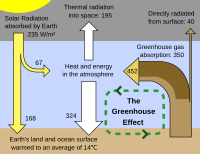
 The greenhouse effect is the process by which absorption and emission of infrared radiation by gases in the atmosphere warm a planet's lower atmosphere and surface. It was discovered by Joseph Fourier in 1824 and was first investigated quantitatively by Svante Arrhenius in 1896.[19] Existence of the greenhouse effect as such is not disputed, even by those who do not agree that the recent temperature increase is attributable to human activity. The question is instead how the strength of the greenhouse effect changes when human activity increases the concentrations of greenhouse gases in the atmosphere.
Naturally occurring greenhouse gases have a mean warming effect of about 33 °C (59 °F).[20][C] The major greenhouse gases are water vapor, which causes about 36–70 percent of the greenhouse effect; carbon dioxide (CO2), which causes 9–26 percent; methane (CH4), which causes 4–9 percent[not in citation given]; and ozone (O3), which causes 3–7 percent.[21][22] Clouds also affect the radiation balance, but they are composed of liquid water or ice and so are considered separately from water vapor and other gases.
Human activity since the Industrial Revolution has increased the amount of greenhouse gases in the atmosphere, leading to increased radiative forcing from CO2, methane, tropospheric ozone, CFCs and nitrous oxide. The concentrations of CO2 and methane have increased by 36% and 148% respectively since the mid-1700s.[23] These levels are much higher than at any time during the last 650,000 years, the period for which reliable data has been extracted from ice cores.[24] Less direct geological evidence indicates that CO2 values this high were last seen about 20 million years ago.[25] Fossil fuel burning has produced about three-quarters of the increase in CO2 from human activity over the past 20 years. Most of the rest is due to land-use change, particularly deforestation.[26]
CO2 concentrations are continuing to rise due to burning of fossil fuels and land-use change. The future rate of rise will depend on uncertain economic, sociological, technological, and natural developments. Accordingly, the IPCC Special Report on Emissions Scenarios gives a wide range of future CO2 scenarios, ranging from 541 to 970 ppm by the year 2100.[27] Fossil fuel reserves are sufficient to reach these levels and continue emissions past 2100 if coal, tar sands or methane clathrates are extensively exploited.[28]
The destruction of stratospheric ozone by chlorofluorocarbons is sometimes mentioned in relation to global warming. Although there are a few areas of linkage, the relationship between the two is not strong. Reduction of stratospheric ozone has a cooling influence, but substantial ozone depletion did not occur until the late 1970s.[29] Tropospheric ozone contributes to surface warming.[30]


More information concerning Global Warming at WIKIPEDIA.

My post is dedicated to " Blog Action Day " ( 15/10/2009 ) concerning climate change around the world.


, , , , ,

5 Sites To Learn How To Repair Your Own Computer

[ Sunday, October 11, 2009 | View Comments ]


Have you ever had a problem with your own computer and gotten a quote from one of those box stores?  Holy cow ! I know a guy who got a virus, took his tower (PC) to a store and paid several hundred rupees to have them install an anti-virus program and “save the day.” ! I am serious, several hundred rupees!  OK, I understand that a laborer is worthy of his hire, but I believe that every single one of us would jump on the chance to save a few bucks if we could.

If there was any possibility to do some of those PC repairs on your own, and therefore save a few rupees, is that something you’d learn how to do? Here are five links that will help you with those computer repair jobs. 


(1) Fixing My Computer… 100% free step-by-step guide


If you can get by the pink, blue, and green pastel colors, this site can be a real great resource in you journey to Do It Yourself computer repair proficiency. Once you arrive at this site, you’ll easily find, along the left hand side, a nifty menu system obviously designed to look like a file explorer.  On that menu you’ll find categories for almost any kind of fix you can think of.  Check out a few of them and see if a problem you are having is covered.


(2) Yahoo Answers Community – Computers & Internet


I know, there are many communities out there on the internet that are ready and willing to give answers to your questions for nothing more than a few kudos.  Yahoo Answers is just one of the communities that I’ve had the most luck with.  For some tips on computer problems you are having, ask the community over in the Computers &  Internet section and you’re sure to find some answers!  Do what I do.  Begin by searching through the many questions already answered.  Odds are someone else had the same, or similar, problem that you are having so avoid the fuss of re-asking the same question.

(3) LaptopMag.com – 11 Ways to Fix Your Laptop


To pinpoint the most common problems, we picked the brains of senior technical-support officials at Alienware, Dell, Lenovo, Acer and Toshiba. And we’ve provided solutions for getting your laptop back up and running with minimal effort.

You can go through each one of the 11 pages or you can use the little dropdown menu at the bottom of each page to jump the the topic you need.  This article covers topics such as overheating, battery problems, network issues, and virus or spyware infestation, which i think is your problem.  Like I said, the basics are covered here. They’re not exhaustive, but a really good start !

(4) Lifehacker’s Top 10 Computer Hardware Fixes and Upgrades


Some of us will never get to the point where we will be wanting to build a PC from scratch, like number 1 on LifeHacker’s top 10 list of computer hardware fixes and upgrades, but some of these fixes or upgrades are easy enough for most of us.  I’ve used my own good opinion to rate the number one’s on this list: Easiest fix on the list?  Changing or upgrading RAM on a laptop (unscrew a few screws and that’s about it); Most creative? Using elastic strips to quiet a noisy hard drive; Most difficult or involved?  Starting from scratch on your own PC.  Good list and a great help.

(5) Fixed4free.com – Computer category


This site is more of an answers community.  It seems pretty exhaustive in the computers category.  The site is fairly easy to use – if you notice, the white speech balloons mean that there is no answer yet and a green speech balloon means there is an answer.  Browse around and see if you can find an answer to your question.  If not, it seems that there is a section that allows you to ask a question.  Check out this post (because I think its funny): i wanna go on bebo but i cant in skwl?.

I already learned a new trick from the site: My computer screen as turned upside down how do i turn it back?. Check it out and see what you can learn!

Answer: Press Control + Alt + Up...that should fix it if not go to your desktop left click -->Graphics Properties and turn it right side up :)

As a word of warning, there are obviously some repairs that not every person is capable of accomplishing on their own.  If you are over your head, and you KNOW it, seek help, probably even professional help.  The purpose of this post is to save you some dough on some things that you ARE capable of doing, once you know how.

Do you know of any other online sources that help with  pc repair?  Feel free to share in the comments ! :)


 Source: Make Use Of

, , , ,

Transformers 3 Confirmed for 2011

[ Sunday, October 4, 2009 | View Comments ]

Good News Transformers Fans, Michael Bay, the director of Transformers said that, this Thursday that he will shoot a third "Transformers" film, whose release date has been brought forward by exactly one year to July 1, 2011. LOL !

Our Stars, Shia LaBeouf and Megan Fox are slated to return to the Paramount/DreamWorks project, as is Ehren Kruger, the co-writer of this year's hit sequel "Transformers: Revenge of the Fallen." The first two films have grossed more than $1.5 billion worldwide. :$


Bay wrote on his Web site that he met with George Lucas' ILM effects house in San Francisco Thursday morning, and then flew with Kruger to talk new characters with Hasbro executives in Rhode Island."Well, it's official: We have a great 'Transformers 3' story," Bay said on his Web site. "Today is Day One."
Paramount's summer 2011 is shaping up to have four tentpoles: Marvel features "Thor" and "First Avenger: Captain America" bow May 20 and July 22, respectively. And the DreamWorks Animation sequel "Kung Fu Panda: The Kaboom of Doom" hits theaters June 3.


(Editing by DGoodman at Reuters)


From, abc News Entertainment

We hope this time that we enjoy more action, experience new effects, bigger giant toys, better, longer & have more explosions... No word on whether Shia LeBeouf and his molester’s goatee will make an appearance, but if you’ve been sorely lacking an actor screaming, “NO!” and running repeatedly I’d imagine you’ll soon be in robot heaven. Like he went to, In T2 and the return of the Decepticons who was left to be exterminated in Transformers Revenge of the Fallen ! : )

I’d imagine Transformers 3 will not do as much business as the second movie, because once you get punched in the face once, generally you duck. Also, there’s no way we will all be as enthusiastic to see Megan Fox after two more years of ridiculous shiz flying out of her mouth. Unless you’re the next step. And a better man than I. LOL : ))

See you @ Cannon on the 1st of July 2011 ! :p
, , ,

Nokia Creates Vibrating Braille Solution

[ Saturday, October 3, 2009 | View Comments ]

Nokia has developed a  new possible solution for anyone who cannot read text on a mobile phone screen, that is blind people. This was done by implementing a new system of reading braille on a touchscreen handset. The Nokia Braille Reader, still in beta version, utilizes the Braille alphabet while leveraging tactile feedback in mobile phones.


This advance  technology is a product of a joint venture, between Nokia, Tampere University and the Finnish Federation of the Visually Impaired. The Nokia Braille Reader was encoraged by a Canadian Radio-television and Telecommunications Commission (CRTC) mandate of wireless organizations to provide at least one device that supports the needs of blind or people with cognitive or mobility disabilities.

According to Nokia Company, the technology is compatible with its S60 handsets, including the Nokia 5800 XpressMusic :) , Nokia N97, Nokia N97 mini, Nokia 5530, Nokia 5230 and Nokia X6.[1]


The mobile phone as a communication tool is pretty universal when it comes to voice calls, but phones are just as popular for sending text messages as they are for chatting with each other. That is a problem for one set of users who are either partially sighted or completely blind. Nokia has now come up with a possible solution for anyone who cannot read text on a screen by implementing a new system of reading braille on a touchscreen phone.


The Nokia Braille Reader Application (NBRA) has been developed at Nokia Beta Labs. Each text message is fed into the NBRA and the characters converted into braille. Then each character is read out to the user using the vibrating facility of the phone. As braille is a series of raised dots each character can be communicated by changing the vibration to depict raised or not with a whole sequence allowing the user to figure out which character it is. After a short time of using NBRA it should become easy for the user to understand quickly what the characters are based on the vibrations being emitted.
Playback of the text message is only done when a finger is touching the screen which allows the user to pause at any time by lifting their finger off the screen. Large buttons have also been placed in set areas on the screen for different functionality like entering and exiting NBRA; making it easier for the user to navigate to and from the app. Best of all it is totally free to download and use and is compatible with phones based on S60 5th edition such as the N97, N97 mini, 5800 XpressMusic, 5530, 5230, and X6 handsets.

Matthew’s Opinion
There are already solutions for the blind that allow text messages to be read out, but that is not always going to be ideal. Maybe the text message contains information you would rather not share with those around you, and it’s not always possible to wear headphones tolisten to messages. Nokia’s solution is very discreet as it is completely silent.
The one drawback of such a system is how much of a battery drain it may be. Vibrating the phone a lot is going to sap your battery quite quickly, but I don’t know how it compares to reading out texts in terms of which one uses more juice. I’m sure you are still going to get a day’s use out of your Nokia handset though, even if you are texting a lot.
I also wonder if the system could be reversed allowing users to write texts using this vibrating braille system. If different taps on the screen can set the vibration feedback then it could be quite easy to achieve.


Nokia Braille Reader gives SMS for the blind and visually impaired. It captures received SMS messages and brings them to the foreground for reading using Braille and tactile feedback.

From, Geek

A video about the Braille technology, from Nokia Business Development


In my opinion, the advent of Nokia Braille Reader, an experimental application that gives SMS for the visually impaired is a great idea developed by Nokia and Associates. It captures received SMS messages and brings them to the foreground for reading using Braille and tactile feedback. I personally believe that this innovation shall bridge the gap between people having vision problems and the so-called " normal " people. I look forward that in the near future, I come across a "Blind Programmer". I shall expect that D-Day with great anticipation ! Long Live Nokia though I don't have a Nokia mobile !  :)

, , , , , , ,

Transformers Revenge of the Fallen

[ Tuesday, September 29, 2009 | View Comments ]

The Decepticon forces return to Earth on a mission to take Sam Witwicky (Shia LaBoeuf) prisoner, after the young hero learns the truth about the ancient origins of the Transformers. Joining the mission to protect humankind is Optimus Prime, who forms an alliance with international armies for a second epic battle.

And it has been two years since young Sam Witwicky saved the universe, averting a global battle between rival militant alien race of robots. Despite their heroic feats, Sam remains normal teenager with normal problems as usual - admission to college and parents. Of course, the departure will be taken seriously the best friend, the robot - Bumblebee bodyguard...

Awesome movie  !!! Better than G.I Joe as always !


The battle for Earth has ended but the battle for the universe has just begun. After returning to Cybertron, Starscream assumes command of the Decepticons, and has decided to return to Earth with force. The Autobots believing that peace was possible finds out that Megatron's dead body has been stolen from the US Military by Skorpinox and revives him using his own spark. Now Megatron is back seeking revenge and with Starscream and more Decepticon reinforcements on the way, the Autobots with reinforcements of their own, may have more to deal with then meets the eye.

The movie which was released on June 19, 2009 in the United Kingdom and June 24, 2009 in North America.It is the sequel to 2007's Transformers, which was the first live action Transformers film. Michael Bay and Steven Spielberg return respectively as director and executive producer, while Shia LaBeouf reprises the role of Sam Witwicky, the human caught in the war between Autobots and Decepticons. The film introduces many more robots and the scope has been expanded to numerous countries, most notably France and Egypt.

From my point of view, this awesome movie will be the best movie of 2009, as we have micheal Bay as Director & Steven Spielberg as executive producer. I thought it would be officially released on the 24th of June, but it was already out in UK the 19th June.

This is great movie that adults and also children would appreciate, with :

the Autobots,

Optimus Prime: The Autobots’ leader – alternate form: Peterbilt truck.

Ironhide: Weapons specialist – GMC Topkick.


Starscream: Formerly Megatron’s second in command, he escaped at the end of the first movie; F-22 Raptor jet.

Scorponok: The mechanical scorpion that attacked the American troops in the desert.

The Fallen: An ancient robot, sort of the Transformers’ version of Lucifer. He’s one of the original robot aliens, and his defiance and arrogance led to his banishment into another dimension. The screenwriters call him “the most elemental bad guy” and say that The Fallen holds the key to life on both Earth and Cybertron, the Transformers’ home planet.

Sideways: The Audi R8 seen crashing through a building in the trailer.
Soundwave: A cassette player in the original toys. An evil communications expert but this time in the form of an orbiting space satellite.
Ravage: The ultimate spy. A four-legged, cat-like robot. Ravage doesn’t turn into anything. “In the spirit of ‘more than meets the eye,’ Ravage isn’t just lethal because of his sharp teeth,” says screenwriter Alex Kurtzman. “There’s actually another skill set Ravage has that didn’t exist before, so there’s going to be a surprise for fans.” He doesn’t talk like the other Transformers.

The Doctor: A spider-like droid that transforms into various implements of torture.

Wheelie: A small, radio-controlled truck.

Demolisher: One of the Constructicons that transform into construction vehicles.
Devastator: A giant robot formed by the Constructicons joining together; individually, they are: Scavenger, Scrapper, Hightower, Longhaul, Rampage, Overload and Mixmaster. “He’s made of vehicles designed to build, and he turns into is someone who loves to destroy,” Orci says. “He is an agent of absolute chaos.” Michael Bay says that when Steven Spielberg saw Devastator, he said “This is (expletive) awesome!’ ” Bay says, “It’s always nice when you can make him swear.”

Megatron: the powerful and utterly ruthless evil leader of the Decepticons and the primary antagonist of the series.

[gallery]

Also if you want further details about the movie, or if you want to download its Soundtracks , the movie & Tailers, do visit :


Transformers 2 Revenge of The Fallen (2009) CAM - The Movie

Transformers 2 Revenge of the Fallen - OST (2009) - Revenge Of the Fallen Soundtracks

"New Divide" Trailer Video By Linkin Park ( FLV format ) - Linkin Park "New Divide Trailer"

Michael Bay ShoWest Transformers 2 Montage Amazing HD - Transformers 2 Montage

Transformers Revenge Of The Fallen (Xbox360) - The game on XBOX

TransFormers Revenge of the Fallen (PC) - The Game on PC

or if you want visit the source @ http://knight-nirvan.blogspot.com

For The Names of the actors, actress, robot's voice etc.. visit http://www.imdb.com/title/tt1055369/fullcredits#cast
, , ,

‘Transformers: ROTF’ is Out! Reviews, Unfortunately, are In…

| View Comments ]


When the original Transformers was released in 2007, it became the surprise hit of the summer: it opened on a Monday evening, and by the following Sunday it had made $155.4 million dollars. Final tally? $319.2 million. (And that’s the domestic gross alone. LOL !!!)

The reviews were also solid — for a summer movie, anyway. Of all the reviews listed on Rotten Tomatoes, 57% of them were positive. RT’s consensus? “While believable characters are hard to come by in Transformers, the effects are staggering and the action is exhilarating.”


In other words, it was a classic example of a good Michael Bay movie.

Not to be preaching doom on a site called Transformers Movie Buzz, but the responses so far for Transformers: Revenge of the Fallen seem to indicate that it’s a bad Michael Bay movie.

For a direct comparison, the Rotten Tomatoes score is now at 21% — 31 positive reviews versus 115 negative reviews. But it’s the content of the reviews themselves that tell a bigger story. Ain’t it Cool News, the granddaddy of movie fanboy sites, has four different editorial reviews up, and they’re all negative. Here’s a taste:

The film is padded by an hour of completely unnecessary, worthless, offensive and repugnant sequences that do nothing but tread water. Be it the family dogs f***ing, twice. An extended sequence of Mom hopped up on pot brownies on a reefer madness binge. Then we’ll talked about racist foul-mouthed robots that are built in monkey proportions, have a big shiny gold tooth and do nothing to advance the story an inch.

And

[A]ll this leads to the worst sin of the film. It’s called TRANSFORMERS. And yet, 90% of the film is spent entirely with the above collection of tools and occasionally Bumblebee who has mysteriously lost his voice again. Sure, the film OPENS with Optimus Prime and all the badasses from the previous film. But they’re barely in this film at all. It’s more about Shia and Megan running around, collecting incompetent sidekicks while half-assing their way through an Indiana Jones plot. Ironhide? Ratchet? They’re all back at the base. They could only spare a pair of sambot jackasses for THE MOST IMPORTANT MISSION, LIKE, EVER!

If you prefer your reviewers established and respected, here’s Roger Ebert’s one star review:

“Transformers: Revenge of the Fallen” is a horrible experience of unbearable length, briefly punctuated by three or four amusing moments. One of these involves a dog-like robot humping the leg of the heroine. Such are the meager joys. If you want to save yourself the ticket price, go into the kitchen, cue up a male choir singing the music of hell, and get a kid to start banging pots and pans together. Then close your eyes and use your imagination.

Well hey, it’s inspiring new creative insults, so that can’t be all bad. To end on a positive note, here’s Owen Gleiberman’s “B” review for Entertainment Weekly:

At last year’s Comic-Con convention, several representatives of Revenge of the Fallen appeared with the slogan ”Bigger. F—ing. Robots.” on their T-shirts, and Bay, taking that cue, knows just what his job is relative to the first Transformers (2007): It’s to make the movie huger, louder, smashier, and — on the mechanical level — more crazily, audaciously imaginative. He succeeds…Revenge of the Fallen may be a massive overdose of popcorn greased with motor oil. But it knows how to feed your inner 10-year-old’s appetite for destruction.
, ,

UFOs - The Unsolved Mystery in Mauritius

| View Comments ]

Some months back on the 11th April of 2009 I, myself and my brother sighted a strange small star moving at a very low speed. We thought that is was an ordinary polar satellite which was travelling from north to south. But unfortunately, while comparing its speed it was unusual. Indeed the speed of a satellite is very high, but this one was very strange.


As a matter of fact UFO means Unidentified flying object (commonly abbreviated as UFO or U.F.O.) is the popular term for any aerial phenomenon whose cause cannot be easily or immediately determined. Both military and civilian research show that a significant majority of UFO sightings have been identified after further investigation, either explicitly or indirectly through the presence of clear and simple explanatory factors (see Occam's Razor). The United States Air Force, which coined the term in 1952, initially defined UFOs as those objects that remain unidentified after scrutiny by expert investigators, though the term UFO is often used more generally to describe any sighting unidentifiable to the reporting observer(s). Popular culture frequently takes the term UFO as a synonym for alien spacecraft. Cults have become associated with UFOs, and mythology and folklore have evolved around the phenomenon. Some investigators now prefer to use the broader term unidentified aerial phenomenon (or UAP), to avoid the confusion and speculative associations that have become attached to UFO.

Studies have established that only a small percentage of reported UFOs are actual hoaxes, while the majority are observations of some real but conventional object—most commonly aircraft, balloons, or astronomical objects such as meteors or bright planets—that have been misidentified by the observer as anomalies. A small percentage of reported sightings (usually 5 %–20 %) are classified as unidentified flying objects in the strictest sense

Certain scientists have argued that all UFO sightings, in the strictest sense, are misidentifications of prosaic natural phenomen and historically, there was debate among some scientists about whether scientific investigation was warranted given available empirical data. Very little peer-reviewed literature has been published in which scientists have proposed, studied or supported non-prosaic explanations for UFOs.

UFO reports became frequent after the first widely publicized US sighting – reported by private pilot Kenneth Arnold in 1947 – that gave rise to the popular terms "flying saucer" and "flying disc". Since then, millions of people have reported that they have seen UFOs.

Courtesy from (Source) http://en.wikipedia.org/wiki/UFO

In point of fact, at that very moment my camera was with me. I immediately took it about ans started filming. But unluckily my camera's memory was limited, that is I had already used part of the memory to take pictures. Luckily I had recorded part of the scene. I have posted this video on "Youtube" & some friend intimated me that this a usual case in US. On the other hand it was the first time in MAURITIUS. Below I embedded it, sorry for the bad quality. However you can  refer to this link to watch it in HD ( http://www.youtube.com/watch?v=YJvmaP4P0YE )


Still Many people had encountered this 'UFO' but the Area 51 guys!!!!


Update 1: I got someone on my other Blog saying that : "yes bro, I am mauritian too, check out above the colline candos,4:30 - 5:00 in the morning and you will tell. You won't believe it. Of course many people will think you are this and that when you tell it to them. " - By anony.